Getting Started with Python
Where Python is Applied
5 min read
Python is already in your daily life
You've probably used Python-powered software today without knowing it. The recommendation that appeared on your streaming service, the spam filter that caught a suspicious email, the route your navigation app suggested — all of these systems were likely built with Python somewhere in their stack.
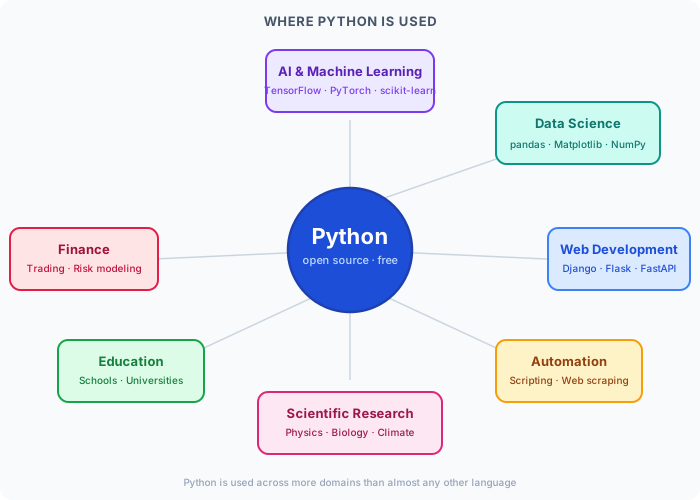
Let's walk through the major domains where Python is applied.
1. Artificial Intelligence and Machine Learning
This is where Python dominates most visibly today. Nearly every major AI research lab and AI company — Google, OpenAI, Meta, Anthropic — uses Python as their primary language.
Why? The libraries. Python's AI ecosystem is the richest of any language:
- scikit-learn — classic machine learning algorithms (decision trees, regression, clustering)
- TensorFlow — Google's deep learning framework, used in production at global scale
- PyTorch — Meta's research-first deep learning library, now used by most AI researchers
- Hugging Face Transformers — the toolkit that powers most modern language models
When a team builds something like a chatbot, an image classifier, or a medical diagnosis tool, they almost certainly write it in Python.
2. Data Science and Analytics
Data scientists use Python to clean, analyze, and visualize data. A typical workflow might look like:
- Load a dataset from a CSV file
- Remove duplicates and fill in missing values
- Compute averages, trends, and correlations
- Plot charts to identify patterns
- Share insights with a team
Python's pandas library handles steps 1–4 almost entirely on its own. Matplotlib and Seaborn handle the charting. A data scientist can go from raw data to a finished report in an afternoon.
Examples in practice:
- A hospital analyzing patient readmission rates to identify at-risk patients early
- A retailer studying buying patterns to decide which products to restock
- A journalist analyzing years of financial records to spot discrepancies
3. Web Development
Python is used to build the behind-the-scenes logic of websites — the part that handles your login, saves your data, and returns results when you search.
Popular Python web frameworks include:
- Django — "batteries-included" framework used to build Instagram, Pinterest, and Disqus
- Flask — lightweight and flexible, good for smaller apps and APIs
- FastAPI — modern framework optimized for building fast APIs, very popular for AI-powered services
When you sign up for a website and your account information gets saved and a welcome email gets sent — that backend logic is often Python.
4. Automation and Scripting
This is Python at its most practical for everyday users. Automation means writing a small program to handle a task you'd otherwise do manually, over and over.
Real examples:
- File organization — rename 200 photos from a folder based on the date they were taken
- Report generation — pull numbers from a spreadsheet every Monday and email a summary to your team
- Web scraping — automatically collect product prices from a website and save them to a spreadsheet
- Testing — automatically check that a web app's buttons and forms work correctly after every update
You don't need to work in tech to use Python for automation. Anyone who spends time doing the same repetitive computer task repeatedly can save hours with a Python script.
5. Scientific Research
Python became the standard tool in many scientific fields during the 2010s, largely because it's free, readable, and powerful enough for serious computation.
Physics: The team that first imaged a black hole (Event Horizon Telescope, 2019) used Python to process the data.
Biology: Researchers use Python to analyze DNA sequences, model protein folding, and process microscopy images.
Climate science: Climate models and weather prediction systems use Python to process enormous datasets from satellites and sensors.
Economics: Economists use Python to build models, run simulations, and test policy scenarios.
6. Education
Python is now the most commonly taught programming language in schools and universities worldwide. The reasons map directly to the things we've already covered: it's readable, free, and works across many domains.
The UK made programming a required subject in its national curriculum and recommended Python as the first language. Similar shifts happened in the US, India, and Australia.
This matters for you: the skills you develop in this course are the same skills being taught to millions of students around the world right now.
7. Finance and Trading
Banks, hedge funds, and fintech startups use Python to:
- Analyze financial market data
- Build algorithmic trading systems
- Model risk across large portfolios
- Detect fraudulent transactions in real time
Python replaced older tools like MATLAB in many finance roles because it's free, faster to write, and connects easily to the same libraries used in data science.
Key takeaway
Python is applied across more domains than almost any other programming language: AI, data science, web development, automation, scientific research, education, and finance. Whatever direction you want to go with technology, Python is likely already there.
What's next?
Enough about what Python is and where it's used. It's time to get hands-on. The next lesson walks you through exactly how to download and install Python on your computer — step by step, for both Windows and Mac.