Getting Started with Python
What is Python?
3 min read
Have you ever given step-by-step directions?
Think about telling someone how to make a sandwich. "Get two slices of bread. Spread peanut butter on one side. Add jelly. Press the slices together." Each instruction is clear, specific, and ordered.
Programming works exactly the same way. A program is just a list of instructions that a computer follows — one at a time, in order. Python is a language for writing those instructions.
So what exactly is Python?
Python is a programming language — a way of writing instructions that a computer can read and carry out.
What makes Python special compared to other programming languages is how readable it looks. Python was designed from the start to feel as close to plain English as possible. Compare these two examples that do the same thing:
In a lower-level language (C):
for (int i = 0; i < 5; i++) {
    printf("Hello!\n");
}
In Python:
for i in range(5):
    print("Hello!")
Python's version reads almost like a sentence. That's not an accident — it's how Python was built.
Who created Python?
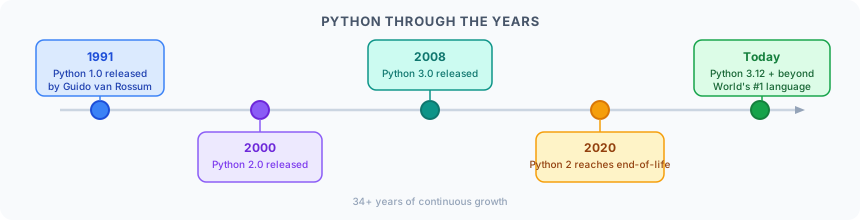
Python was created by a Dutch programmer named Guido van Rossum and first released in 1991. He named it after the British comedy show Monty Python's Flying Circus — so the language has humor baked into its DNA from day one.
Guido's guiding principle was that code should be easy to read, even by someone who didn't write it. This idea became the foundation of Python's design.
Python is for beginners — and for professionals
This is the part that surprises most new learners: Python isn't a "starter" language that you abandon once you get serious. The same language that's perfect for absolute beginners is used by:
- NASA scientists to analyze spacecraft data
- Netflix engineers to build their recommendation engine
- Medical researchers to model disease spread
- Teachers to automate grading
- Journalists to analyze large datasets
Python works at every level. You start simple, and you can go as deep as you want.
What Python looks like up close
Here's a short complete Python program. Even if you've never written a line of code, you can probably follow what it does:
name = "Alex"
age = 20

print("Hello, " + name + "!")
print("You are " + str(age) + " years old.")
Output:
Hello, Alex!
You are 20 years old.
nameandageare variables — containers that hold informationprint()is a command that displays something on screen- The quotes around
"Alex"tell Python that this is a piece of text
You'll understand every part of this — and much more — by the end of this course.
Key takeaway
Python is a beginner-friendly programming language that reads almost like plain English. It was created in 1991 with readability as its core goal, and it has grown into one of the world's most widely used languages for everything from simple scripts to cutting-edge AI.
What's next?
In the next lesson, we'll explore why Python has become so popular — and why it's the right first language to learn today.