Tools of the Trade
Python Libraries for Machine Learning
4 min read
From concepts to code
Everything covered so far in this course — supervised, unsupervised, semi-supervised, and reinforcement learning — describes what machine learning does conceptually. In practice, nearly all of it gets built in Python, using a small set of libraries that handle the heavy lifting.
A quick definition first: Python packages are folders of modules that organize code for easier reuse and maintenance, improving development efficiency. Instead of writing every function from scratch, you install a package once and import exactly the functionality you need.
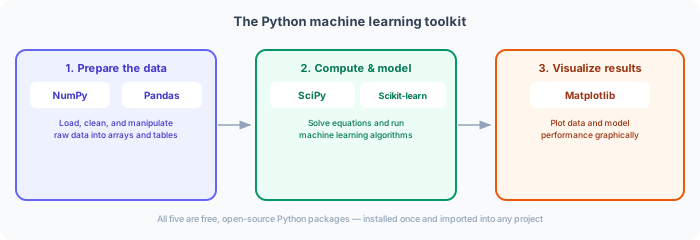
The core libraries
NumPy and Pandas manage the preparation, loading, and manipulation of data. NumPy provides fast, array-based numerical computation — the foundation nearly every other library in this list is built on. Pandas builds on top of that to offer table-like data structures (DataFrames), making it easy to load, clean, filter, and reshape datasets like ABC Inc.'s transaction history.
SciPy solves mathematical equations and processes algorithms — the statistical and mathematical machinery that sits underneath many machine learning techniques.
Scikit-learn offers efficient, ready-to-use versions of common machine learning algorithms — linear regression, logistic regression, support vector machines, decision trees, clustering methods, and more — facilitating the development of machine learning models without having to implement each algorithm from mathematical first principles.
Matplotlib performs data visualization and graphical plotting — the same kind of chart used earlier in this course to show the relationship between data quality and algorithm performance.
What this looks like in practice
Here's a short, realistic sketch of how these libraries work together on a supervised learning problem — training a simple classifier and checking how well it performs:
import pandas as pd                                  # load and manipulate tabular data
from sklearn.model_selection import train_test_split # split data into training and testing sets
from sklearn.linear_model import LogisticRegression  # a supervised learning algorithm
from sklearn.metrics import accuracy_score            # measure how well the model performed

transactions = pd.read_csv("past_transactions.csv")   # Pandas loads the historical data
X = transactions.drop(columns=["is_fraud"])            # the features (inputs)
y = transactions["is_fraud"]                            # the label (correct answer)

X_train, X_test, y_train, y_test = train_test_split(X, y, test_size=0.2)

model = LogisticRegression()
model.fit(X_train, y_train)                             # Scikit-learn trains the model
predictions = model.predict(X_test)

print(accuracy_score(y_test, predictions))              # how often the model got it right
Five imports, a data load, a train/test split, and a fit — that's a genuine, working supervised learning pipeline. Everything conceptual from earlier lessons (labeled data, a model, training, prediction) maps directly onto a handful of readable lines of code.
Course recap
Machine learning refers to a machine's ability to learn from data and replicate patterns of decision-making, rather than following rules a person had to write out in advance.
AI is the broad simulation of human intelligence; machine learning and deep learning are progressively more specific subsets of it, each with unique capabilities for simulating intelligence.
There are four main types of machine learning: supervised learning (labeled data), unsupervised learning (unlabeled data, hidden structure), semi-supervised learning (a mix of both), and reinforcement learning (trial, error, and reward). Which one applies depends entirely on what data is available and what kind of problem is being solved.
And finally, the tools: Python packages like NumPy, Pandas, SciPy, Scikit-learn, and Matplotlib are what turn all of the above from a concept into a running system — organizing code into reusable modules so machine learning projects don't have to be built from scratch every time.
Key takeaway
Machine learning is built in practice using a small, well-established set of Python libraries: NumPy and Pandas for data preparation, SciPy and Scikit-learn for the underlying math and modeling, and Matplotlib for visualization. Together with the concepts from earlier in this course — what machine learning is, how it differs from traditional programming and from deep learning, and the four ways a model can learn — that's the complete foundation for understanding how machine learning systems get built.
What's next?
With the fundamentals in place, the natural next step is to go hands-on: two full practice projects, starting with linear regression on a real housing dataset, followed by logistic regression on the classic Titanic survival dataset — building, training, and evaluating real models from end to end.