Foundations of Machine Learning
Machine Learning Algorithms and the Role of Data Quality
3 min read
What a machine learning algorithm actually does
A machine learning algorithm is a computational procedure that enables a computer to learn patterns from data and make predictions autonomously — without a person hand-coding the specific rule for every case.
Strip away the jargon and a machine learning algorithm exists to do three things for a software application:
- Predict the outcome — given new input, estimate what the answer should be (will this transaction turn out to be fraudulent?)
- Classify the target feature — sort input into the right category (spam vs. not spam, apple vs. pear vs. mango)
- Improve the performance — get measurably better at both of the above as it sees more data and more training iterations
Every algorithm you'll meet later in this course — whether it's used for supervised, unsupervised, semi-supervised, or reinforcement learning — exists to do some combination of these three things.
The algorithm is only half the story
It's tempting to think the hard part of machine learning is picking the right algorithm. In practice, the quality of the data the algorithm is trained on matters just as much — often more.
The quality of the provided data evaluates the algorithm's performance. Feed a strong algorithm noisy, incomplete, or biased data, and it will produce noisy, incomplete, or biased predictions. Feed even a relatively simple algorithm clean, representative, well-labeled data, and it can perform surprisingly well.
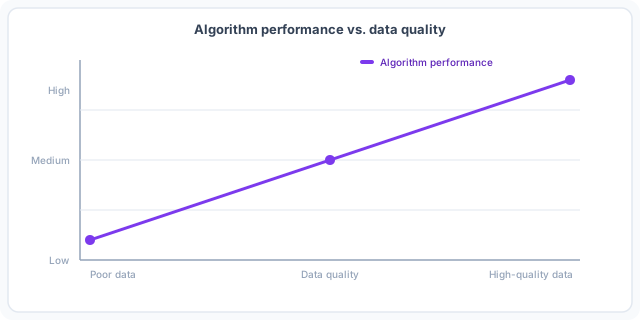
A positive correlation between data quality and algorithm performance holds up across nearly every real-world machine learning system. This is the same principle from ABC Inc.'s fraud detection case: a model trained on a large, clean history of transactions can catch fraud patterns a rules engine never could — but that same model trained on incomplete or mislabeled transaction history will make unreliable calls, no matter how sophisticated the algorithm underneath it.
What "poor data" actually looks like
Data quality issues aren't always obvious. Common ones include:
- Missing values — gaps in the historical record that force the algorithm to guess or discard examples
- Inconsistent labeling — the same kind of event recorded differently across time or teams
- Unrepresentative samples — training data that doesn't reflect the full range of cases the model will see in production
- Outdated data — patterns that were true a year ago but no longer reflect current behavior (fraud tactics, in particular, shift constantly)
Any one of these can quietly cap how good a model can ever become, regardless of how much effort goes into the algorithm itself.
Key takeaway
A machine learning algorithm's job is to predict outcomes, classify inputs, and improve with more data — but how well it does any of that depends heavily on the quality of the data it learns from. Data quality and algorithm performance move together: better data reliably produces better predictions, and no algorithm can fully compensate for bad data.
What's next?
With the foundations in place — what machine learning is, why it took off, how it relates to AI and deep learning, where it shows up, and what its algorithms actually need — it's time to get specific. Machine learning comes in four distinct types, each suited to a different kind of problem. That's the focus of the next section.