The Four Types of Machine Learning
Semi-Supervised Learning
3 min read
The practical middle ground
Semi-supervised learning is a type of machine learning that uses a combination of a small amount of labeled data and a large amount of unlabeled data for training.
Like supervised learning, it aims to learn a function that can accurately predict the output variable from the input variables. But it also uses the unlabeled input to assist the learning process — collecting more information from it or improving how well the model generalizes — the way unsupervised learning does. That combination is exactly why semi-supervised learning falls between supervised and unsupervised learning, rather than belonging fully to either one.
Why this category exists at all
Fully supervised learning needs every training example labeled, and labeling is often the most expensive part of a machine learning project — it usually requires a human to look at each example and tag it correctly. Fully unsupervised learning skips labeling entirely, but loses the precision that comes from having a clear answer key.
Semi-supervised learning is the practical answer to a common real situation: you have a modest number of labeled examples, and a much larger pool of unlabeled data that would be too expensive or too slow to label by hand. Rather than throwing the unlabeled data away, semi-supervised learning finds a way to put it to work.
Example: Google Photos
Google Photos is a popular example of semi-supervised learning. Whenever a picture is taken, it gets stored in the Google Cloud platform or a database. In various instances, uploaders label images themselves — tagging a person's name, for instance. Despite Google's app having no built-in knowledge of who that person is, its algorithm can learn to recognize them in future, unlabeled photos by analyzing visual features like shapes and colors.
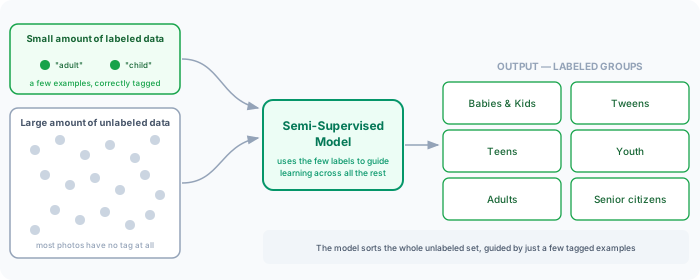
A handful of tagged photos give the model something to anchor to. From there, it extends that learning across a much larger library of photos nobody ever manually tagged — this data set contains both labeled and unlabeled data, which is exactly the condition that calls for semi-supervised learning.
When to reach for semi-supervised learning
- You have some labeled data, but not nearly enough to fully cover the problem
- Labeling more data would be possible, but slow or costly at scale
- You still need reasonably precise predictions — more precision than pure unsupervised learning typically offers
Key takeaway
Semi-supervised learning combines a small labeled dataset with a much larger unlabeled one, using the labeled examples to guide what the model learns from the rest. It captures much of the precision of supervised learning without requiring every single example to be labeled by hand — exactly the trade Google Photos makes when it learns to recognize faces from just a few tagged photos.
What's next?
The first three types of machine learning all learn from a dataset that already exists. Reinforcement learning throws that assumption out entirely — it learns by acting and seeing what happens.