The Four Types of Machine Learning
The Four Types of Machine Learning: An Overview
3 min read
One name, four fundamentally different approaches
So far, "machine learning" has been treated as one idea. In practice, it splits into four main categories, each distinguished by how it self-trains, what kind of guidance it needs, and what kind of outcome it's built to produce.
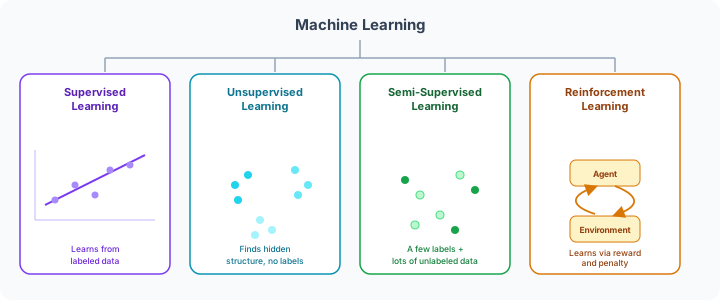
The four categories, at a glance
Supervised learning trains on labeled data — every example comes with the correct answer attached — and learns to map inputs to outputs. It's the most common starting point for machine learning projects, and it's what powers common algorithms like regression and classification.
Unsupervised learning works with unlabeled data and looks for hidden structure on its own — most commonly by clustering similar examples together without being told what the groups should be.
Semi-supervised learning sits between the two: it trains on a small amount of labeled data combined with a much larger pool of unlabeled data, using the unlabeled examples to improve what it learns from the few labels it has.
Reinforcement learning takes a completely different approach — instead of learning from a fixed dataset at all, it learns through trial and error, taking actions in an environment and adjusting its strategy based on the rewards and penalties it receives.
Why the distinction matters
Choosing the right category isn't a technicality — it's determined by what data you actually have and what kind of problem you're solving:
- Have a large set of correctly labeled examples and a specific outcome to predict? Supervised learning.
- Have plenty of data but no labels, and want to discover what natural groups or patterns exist? Unsupervised learning.
- Have a little labeled data and a lot more unlabeled data than you can afford to label by hand? Semi-supervised learning.
- Have no fixed dataset at all, but an environment where an agent can try things and get feedback? Reinforcement learning.
The next four lessons take each of these in turn — what they need, how they work, and where they show up in practice.
Key takeaway
Machine learning splits into four main categories: supervised learning (learns from labeled data), unsupervised learning (finds structure in unlabeled data), semi-supervised learning (a mix of both), and reinforcement learning (learns through trial and error and reward). The right one to use depends entirely on what data is available and what kind of problem needs solving.
What's next?
We'll start with the most widely used category — supervised learning — and the algorithms that power it.