Foundations of Machine Learning
Machine Learning vs. Deep Learning vs. AI
4 min read
Three words, one common mistake
"AI," "machine learning," and "deep learning" show up constantly in headlines, product descriptions, and job titles — often used as if they mean the same thing. They don't. They describe three nested ideas, each one a more specific version of the one before it.
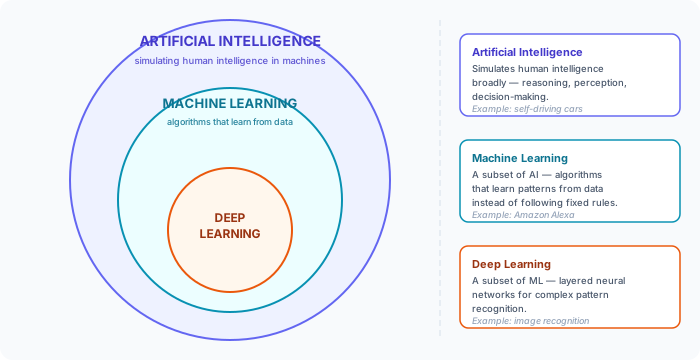
Artificial intelligence: the outermost circle
Artificial intelligence (AI) is the broadest of the three. It refers to the simulation of human intelligence in machines — any system designed to reason, perceive, decide, or act in ways that resemble human intelligence, regardless of how it achieves that.
Example: self-driving cars. A self-driving car has to perceive its environment, reason about traffic rules, predict the behavior of pedestrians and other vehicles, and make continuous decisions — all things we'd call intelligent behavior in a person. That entire system is AI. Under the hood, it relies on machine learning and deep learning to actually work, but "AI" is the umbrella term for the whole capability.
Machine learning: a subset of AI
Machine learning (ML) is one specific way of building AI — the one this course focuses on. It's the subset of AI that focuses on algorithms that enable computers to learn from data, rather than intelligence achieved through any other method (like hand-written rule systems).
Example: Amazon Alexa. When Alexa recognizes your speech and figures out what you're asking for, it's using machine learning models trained on huge amounts of audio and language data — not a fixed list of every possible sentence a person might say.
Deep learning: a subset of machine learning
Deep learning (DL) goes one level deeper still. It's the subset of machine learning that uses neural networks with multiple layers ("deep" refers to the number of layers) to recognize complex patterns — the kind of patterns too intricate for simpler machine learning techniques to capture well.
Example: image recognition. Identifying whether a photo contains a cat, a stop sign, or a tumor on an X-ray requires picking up on subtle combinations of shapes, textures, and pixels. Deep learning's layered neural networks are especially good at exactly that kind of complex pattern recognition — which is why it powers most modern image and speech recognition systems.
Putting it together with a use case: AI playing chess
Consider a chess game between a computer and a person. The computer uses AI broadly to understand the state of the game and decide on a move — but that AI is built from more specific pieces:
- It uses machine learning to classify what kind of opponent it's facing — beginner, intermediate, or advanced — based on the moves they've made so far.
- It uses a deep learning neural network to evaluate the board deeply and decide its next move, learning patterns from a vast history of past games rather than following a fixed strategy chart.
The "AI" is the whole chess-playing system. Machine learning and deep learning are the specific techniques doing the work inside it.
Key takeaway
AI, machine learning, and deep learning are not three competing technologies — they're three nested levels of the same idea. AI is the broad goal of simulating human intelligence. Machine learning is a subset of AI that learns from data instead of fixed rules. Deep learning is a subset of machine learning that uses multi-layered neural networks to tackle especially complex patterns. Every deep learning system is machine learning, and every machine learning system is AI — but not the reverse.
What's next?
Now that machine learning's place in that bigger picture is clear, it's worth seeing exactly where it shows up in products you already use every day.