The Four Types of Machine Learning
Unsupervised Learning
3 min read
No labels, no guidance
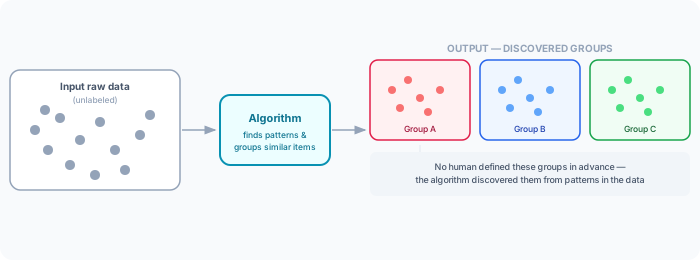
Unsupervised learning allows models to identify patterns and structures in unlabeled data without explicit guidance. There's no correct answer attached to any example — the algorithm has to find whatever structure exists on its own.
The unlabeled dataset is provided to an unsupervised learning algorithm, which needs to find hidden patterns and recognize how examples relate to one another — most often by grouping similar items together.
What makes this different from supervised learning
Supervised learning starts with the answer already attached to each example. Unsupervised learning starts with nothing but the raw data itself. The algorithm isn't told "these are the categories" — it's told "find whatever categories exist." That makes unsupervised learning the right tool when you don't yet know what patterns to look for, or when labeling every example by hand would be too slow or too expensive.
Examples of unsupervised learning in practice
Image segmentation for object detection. Before a system can identify individual objects in a photo, it often needs to first partition the image into meaningful regions — grouping pixels that likely belong to the same object, without being told in advance what those objects are.
Identification of user groups based on commonalities. A business with a large, unlabeled customer base can use unsupervised learning to discover natural groupings — customers who behave similarly — without anyone having predefined what those customer segments should look like.
Identification of anomalies over geographical landscapes. Environmental and geological datasets are often too vast to label by hand. Unsupervised learning can scan patterns in the data and flag regions that look meaningfully different from their surroundings — a potential anomaly worth a closer look.
The trade-off
Because there are no labels to check its work against, unsupervised learning can't be directly graded on accuracy the way supervised learning can. It's a tool for discovery and exploration — surfacing structure a human can then interpret and name — rather than a tool for hitting one specific, pre-defined target.
Key takeaway
Unsupervised learning finds patterns and groupings in data that has no labels, using techniques like clustering to surface structure a human never explicitly defined. It's the right choice when you have plenty of data but don't yet know what categories or patterns exist within it.
What's next?
What if you have a little labeled data and a lot of unlabeled data — more than enough to be useful, but not enough to label all of? That middle ground is semi-supervised learning.