AI in Action: Key Branches and Applications
Generative AI: Creating Something New
8 min read
A different kind of AI
Every AI system we've looked at so far has been fundamentally about analysis: classifying an image, predicting a price, detecting fraud, recommending a product. The model takes in data and returns a verdict about that data.
Generative AI is a different category entirely. Instead of analyzing existing content, it creates new content. It writes text that has never been written. It produces images that have never been photographed. It generates code, audio, and video — original artifacts, not summaries of things that already existed.
This is why generative AI has captured so much attention. It doesn't just automate analysis. It automates creation.
The canonical examples
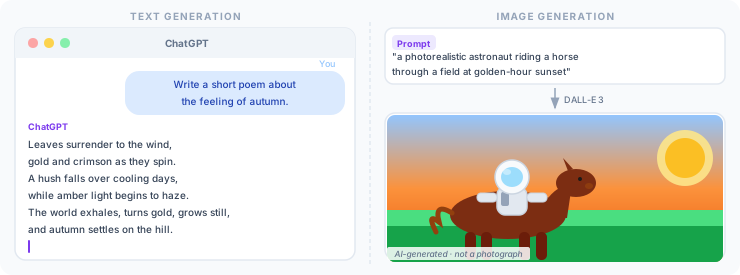
ChatGPT is a text generator. You type a prompt — a question, an instruction, the beginning of a document — and it continues from there. Not by searching a database of pre-written answers, but by generating new text word by word, predicting what should come next.
DALL-E (and its cousins, Midjourney, Stable Diffusion) takes a text description as input — "a photorealistic image of an astronaut riding a horse through a field at sunset" — and renders an original image that matches that description. The image is not a collage of existing photos. It is synthesized pixel-by-pixel from patterns learned during training.
These two examples share a core property: the output is novel. It didn't exist before the prompt was sent. The AI genuinely created it.
The techniques: how generation actually works
Several distinct architectures enable generative AI, each suited to different content types.
Large Language Models (LLMs)
LLMs are trained on massive corpora of text — books, websites, code, academic papers, forum discussions. The training task is deceptively simple: given the previous words, predict the next word. Repeated across hundreds of billions of examples, this teaches the model an extraordinarily rich statistical model of language — not just grammar and vocabulary, but facts, reasoning patterns, code syntax, and argumentation styles.
GPT-4 (the model underlying ChatGPT), Google's Gemini, and Anthropic's Claude are all LLMs. They generate text by sampling from a learned probability distribution: given this context, what word most plausibly comes next? Then given that word as new context, what comes next? Repeat until the response is complete.
The word "large" refers to parameter count — the number of adjustable weights in the model. GPT-3 had 175 billion parameters. Modern frontier models are thought to be significantly larger. Scale turns out to be one of the most reliable levers for improving language model capability.
Visual suggestion: A diagram showing a prompt feeding into an LLM, with the token-by-token generation process illustrated — each new word added to the context before the next one is predicted.
Diffusion Models
Diffusion models are the dominant architecture for image generation today. Their training process is conceptually elegant: take a real image, add increasing amounts of random noise until the image becomes pure static, and train a neural network to reverse that process — to remove noise step by step until a coherent image re-emerges.
Once trained, a diffusion model can generate a new image from pure random noise. Given a text description, a technique called classifier-free guidance steers the denoising process so that the final image matches the prompt.
Stable Diffusion and DALL-E 3 both use variants of this architecture. Diffusion models have largely displaced GANs for image generation because they produce more diverse outputs and are more stable to train.
Generative Adversarial Networks (GANs)
GANs, introduced by Ian Goodfellow in 2014, were the first architecture to produce strikingly realistic synthetic images, and they shaped the early years of generative AI.
The setup is adversarial. Two neural networks compete:
- The generator takes random noise as input and produces a synthetic image. Its goal: fool the discriminator.
- The discriminator sees both real images from the training set and fake images from the generator. Its goal: correctly identify which are real and which are fakes.
Each network improves by competing with the other. The result, after training, is a generator that can produce photorealistic synthetic images.
GANs have been used for face synthesis, style transfer (painting a photograph in the style of Van Gogh), and data augmentation. The adversarial training dynamic makes them powerful but finicky — they can collapse to generating a narrow range of outputs and are notoriously difficult to train.

Neural Radiance Fields (NeRF)
NeRF tackles a specific problem: 3D scene reconstruction from 2D photographs. Given a set of 2D photos of an object taken from different angles, a NeRF model learns a volumetric representation of the scene — essentially building a 3D mental model — and can render that scene from any viewpoint, including angles that were never photographed.
This has clear applications in architecture, product visualization, virtual reality, and film production. A product designer can photograph a prototype from a few angles and generate any viewing angle without building a separate 3D model.
Hybrid Models
The frontier of generative AI increasingly combines architectures. Modern image generators combine a diffusion backbone with a Transformer-based text encoder (to understand the prompt) and a variational autoencoder (to compress and decompress the image representation). ChatGPT combines a base LLM with reinforcement learning from human feedback (RLHF), which fine-tunes the model to produce responses that humans prefer.
These combinations have produced qualitative leaps in capability — coherent long-form writing, photorealistic image generation, and increasingly, video and audio generation — that neither architecture achieves alone.
Where generative AI is creating impact
Entertainment and media
Film studios use AI-generated concept art to visualize scenes before filming. Game developers use LLMs to generate dynamic NPC dialogue. Music composers use audio generation systems to produce backing tracks or sound effects.
Architecture and design
Tools like Midjourney have become standard in early-stage architectural design, allowing architects to rapidly explore aesthetic concepts before committing to detailed CAD work — compressing what was a weeks-long ideation phase to hours.
Healthcare and science
AlphaFold 2, developed by DeepMind, used a Transformer-based generative architecture to predict the three-dimensional structure of proteins from their amino acid sequences — a problem that had occupied structural biology for 50 years. In 2022, it released predictions for over 200 million protein structures, more than all previously known structures combined.
Drug discovery companies use generative models to design novel molecular structures — proposing candidate drug molecules with desired binding properties — compressing years of laboratory screening into computational weeks.
Business content creation
Marketing teams use LLMs to draft product descriptions, email campaigns, and internal documentation. Legal teams use them to draft contract clauses. Customer service platforms use them to generate response suggestions for agents. The efficiency gains are real: a task that took four hours of copywriting can now take 30 minutes of prompt iteration and editing.
The honest trade-offs
Generative AI is powerful. It is also genuinely problematic in ways that matter.
Hallucination: LLMs generate the statistically plausible next token, not the factually correct one. They produce confident-sounding false statements — incorrect citations, fabricated statistics, plausible-but-wrong code. This is not a bug being fixed; it's a fundamental property of the technology. Deployment in high-stakes settings requires human verification.
Intellectual property: Models trained on internet-scraped data have ingested enormous amounts of copyrighted material. The legal and ethical status of this training is actively contested in courts globally.
Synthetic media: The same technology that lets a film studio generate a photorealistic scene lets a bad actor generate a photorealistic video of a public figure saying something they never said. The societal implications for elections, journalism, and public trust in media are serious.
Energy consumption: Training large generative models requires substantial compute. GPT-4's training run was estimated to consume roughly 50 gigawatt-hours of electricity. As these models scale, their energy and water footprint is an increasingly significant consideration.
Understanding these trade-offs is not pessimism — it's what allows organizations to deploy generative AI in ways that capture genuine value while managing real risks.
Key takeaway
Generative AI creates new content — text, images, code, video, audio — rather than just analyzing what exists. The core architectures are Large Language Models (trained to predict the next token), Diffusion Models (trained to reverse the noise-addition process), GANs (two competing networks that push each other toward realism), and NeRF (3D scene reconstruction from 2D photos). The technology is driving major investment and genuine transformation across entertainment, healthcare, science, and business — while raising serious questions about accuracy, intellectual property, synthetic media, and energy use that responsible practitioners must engage with.
What's next?
You've now covered the full landscape of modern AI: how it learns, what data it needs, the core techniques, and the major application domains. The next section of the course turns to the broader implications — what this means for how organizations should think about building, deploying, and governing AI systems.