Key AI Techniques
Deep Learning and Neural Networks
6 min read
What most modern AI has in common
Speech recognition on your phone. Image search on Google. Real-time translation. The filters on your camera. Fraud detection at your bank. Chatbots that write coherent paragraphs.
These are all built on the same foundation: deep learning. Understanding what it is — and why it works so well on complex, unstructured data — is one of the most clarifying things you can know about modern AI.
The key idea: layers of processing
Traditional machine learning algorithms learn a single-step relationship between inputs and outputs. Deep learning works differently. It processes information through many successive layers, each one learning to recognize increasingly abstract features.
This layered processing is inspired by — though not identical to — how the human brain processes sensory information.
The brain analogy
When you glance at a photograph, your brain doesn't process it in one shot. Your visual cortex first detects basic contrasts: edges, light patches, dark patches. Those edges combine into shapes. Those shapes combine into objects. Those objects combine into a scene — and then memory and context turn that scene into meaning.
This is a hierarchy of processing, each level building on the one before it.
An Artificial Neural Network (ANN) works the same way.
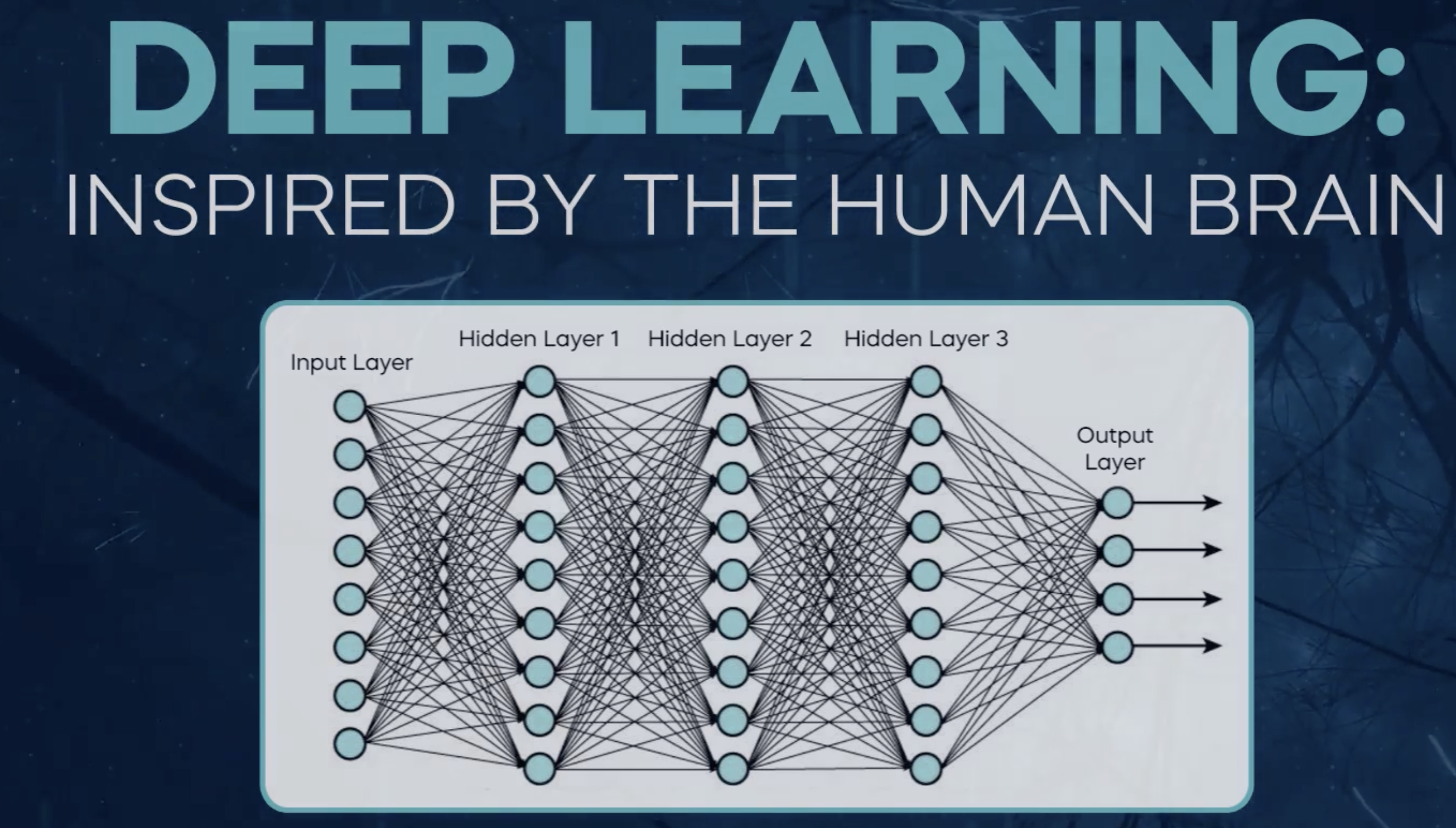
Inside an artificial neural network
A neural network is made of layers, each containing many neurons (nodes). Each neuron receives inputs from the previous layer, applies a mathematical transformation, and passes its output forward.
The three types of layers
Input layer
The entry point. Each node represents one feature of the raw data. For a grayscale image, each node represents the brightness of one pixel. For a loan application, each node represents one attribute (income, credit score, loan amount, etc.).
Hidden layers
The middle layers — where learning happens. Early hidden layers tend to detect simple, low-level features (edges, basic shapes). Later hidden layers combine those into higher-level concepts (faces, objects, patterns). A "deep" network simply means there are many of these layers stacked in sequence.
Output layer
The final layer that produces the model's prediction. For a 10-digit recognition task, the output layer has 10 nodes — one per digit — and the model picks the one with the highest score.
A worked example: recognizing handwritten digits
The MNIST dataset — 70,000 images of handwritten digits — is one of the most widely used teaching examples in machine learning. Each image is 28×28 pixels, in grayscale. Each pixel has a value between 0 (white) and 255 (black).
Here's how a neural network processes one of these images, step by step:
-
Input layer receives 784 values (28 × 28 pixels), each representing a pixel's brightness.
-
First hidden layer detects very basic features — a short horizontal edge here, a diagonal stroke there. Nothing recognizable yet.
-
Second hidden layer combines those edges into curves and corners — the beginnings of partial shapes.
-
Third hidden layer assembles those shapes into higher-level patterns: a closed loop (0, 6, 8, 9), a straight vertical stroke (1, 4, 7), a pair of humps (3, 8).
-
Output layer combines everything and produces a probability for each of the 10 possible digits. The highest-scoring digit is the prediction.
The model wasn't told what edges or curves to look for. It figured those out on its own, from millions of training examples.
Visual suggestion: A side-by-side showing a handwritten "3" as raw pixels on the left, then progressively abstracted representations (edges → curves → number shape) in the middle, and the final prediction "3" on the right.
Why "deep"?
The "deep" in deep learning simply refers to the number of hidden layers. Earlier neural networks had one or two. Modern deep learning systems may have dozens or hundreds.
Each additional layer lets the model recognize more abstract and complex patterns. This is what lets deep learning excel at tasks that were previously out of reach:
- Identifying an object in a photo despite varying angles, lighting, and backgrounds
- Understanding the meaning of a sentence regardless of how it's phrased
- Generating realistic speech from text
- Writing coherent paragraphs in response to a question
Traditional ML vs. deep learning
| Traditional ML | Deep Learning | |
|---|---|---|
| Feature extraction | Designed by a human engineer | Learned automatically from data |
| Data requirement | Thousands of examples | Often millions |
| Handles unstructured data? | Poorly | Very well |
| Interpretability | Relatively clear | Often a "black box" |
| Compute requirement | Low to medium | High |
| Best for | Tabular data, defined features | Images, audio, text, video |
In traditional ML, an engineer decides which features to feed the model (square footage, number of rooms, etc.). In deep learning, the model discovers its own features from raw data — a huge advantage when useful features are hard or impossible to define manually.
Why deep learning only took off recently
Deep learning isn't new — the core mathematics dates back to the 1980s. Two things changed in the 2000s and 2010s that made it practical:
- More data. The internet generated enormous datasets — billions of labeled and unlabeled images, documents, and audio clips.
- More compute. GPUs (graphics processing units), originally designed for video games, turned out to be ideal for the parallel matrix calculations that neural networks rely on. Training time dropped from years to days.
Geoffrey Hinton's 2006 paper revived serious interest in deep neural networks. By 2012, a deep network won a major image recognition competition by such a large margin that the field largely shifted overnight.
Key takeaway
Deep learning is a subset of machine learning that uses neural networks with many layers. Each layer detects increasingly abstract features — from raw pixels or words, all the way to meaningful predictions. This layered feature learning is what makes deep learning so powerful for unstructured data — images, speech, text — and what underpins most of the AI capabilities that have become part of everyday life.
What's next?
With a solid grasp of how AI learns, the next section explores the powerful applications that have emerged from these techniques — including computer vision, robotics, and the generative AI systems behind tools like ChatGPT and DALL-E.