AI in Action: Key Branches and Applications
Robotics: Where AI Gets a Body
7 min read
When intelligence needs to move
So far, every AI system we've discussed lives entirely in software. It reads data, makes a prediction, and returns a number, a label, or a piece of text. But some problems require more than a prediction — they require a physical action. Reaching into a bin to pick a component. Navigating a hospital corridor to deliver medication. Harvesting fruit on an unpredictable stem in a rainstorm.
That's the domain of robotics: the field of designing, constructing, and operating machines that can sense, decide, and act in the physical world.
A longer history than you might expect
Robotics didn't begin with AI. The instinct to build mechanical stand-ins for human action stretches back millennia.
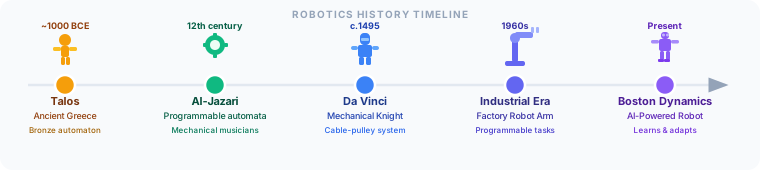
The ancient Greeks imagined Talos, a giant bronze automaton created by the god Hephaestus to patrol the island of Crete. In the twelfth century, the Arab polymath Al-Jazari built programmable musical automata — mechanical musicians driven by a rotating drum with pegs, eerily similar in principle to a music box. In the early sixteenth century, Leonardo da Vinci designed a mechanical knight — a suit of armor with an internal cable-and-pulley system capable of sitting, waving its arms, and moving its jaw — and a mechanical lion reportedly presented to the King of France, capable of walking several steps before opening its chest to reveal a bouquet of flowers.
These were marvels of engineering, but they followed fixed mechanical programs. They couldn't adapt. They couldn't learn. That's the fundamental leap that AI makes possible.
What robotics is today
Modern robotics is an interdisciplinary field in the most literal sense. Building a robot that works reliably in the real world requires at least three distinct areas of expertise working together:
- Mechanical engineers design the physical structure — the joints, the materials, the actuators that convert electrical signals into motion.
- Electrical engineers design the control systems — the circuits, motors, and sensors that connect the mechanical body to the computational brain.
- AI specialists handle the decision-making layer — the software that takes in sensor data and figures out what the robot should do next.
A robot without AI can follow a fixed script. A robot with AI can adapt to conditions it has never seen before.
The AI stack inside a modern robot
When a robot like a warehouse picker or an autonomous delivery vehicle operates in a real environment, it's typically running several AI systems simultaneously — each one solving a different subproblem.
Computer Vision handles perception. Cameras feed image data to a vision model that identifies objects, reads labels, detects obstacles, and locates items in three-dimensional space.
SLAM (Simultaneous Localization and Mapping) handles navigation. SLAM lets a robot build a map of its environment in real time while simultaneously figuring out where it is within that map. Think of it as drawing a map of an unfamiliar building while walking through it in the dark — using only the echoes of your footsteps to infer where the walls are.
Reinforcement Learning handles adaptive decision-making. A robot arm learning to grasp irregular objects doesn't follow a programmed gripping recipe. It runs millions of simulated trials, earns rewards for successful grasps, and learns a policy that generalizes to shapes it has never handled.
Natural Language Processing handles communication. A robot that understands voice commands — "bring this to room 407," "pick up the red container" — needs an NLP layer to parse language into actionable instructions.
These systems work in a continuous loop: sense the world, interpret what you see, decide what to do, act, and immediately sense the result of your action.
Visual suggestion: A circular feedback diagram showing: Sensors (cameras, lidar, microphones) → Computer Vision + NLP (perception layer) → SLAM (map the environment) → Reinforcement Learning (decide the action) → Actuators (motors, grippers) → back to Sensors.
Where robots are working right now
Industrial and hazardous environments
Tesla's Optimus Bot is designed to handle tasks that are dull, dirty, or dangerous — moving components on a factory floor, operating in areas with toxic fumes, doing physical work that humans can do but shouldn't have to. The underlying logic: if the task is repetitive and the environment can be made predictable, a well-trained robot can outperform human workers on consistency and endurance.
Medical robotics
The da Vinci Surgical System allows surgeons to perform minimally invasive procedures with robotic arms that filter out hand tremors and scale down movements to sub-millimeter precision. The surgeon remains in control, but the robot handles the physical translation — turning a broad hand movement into a tiny, precise incision.
Agriculture
Harvesting fruit is one of agriculture's most labor-intensive tasks, and one of the hardest to automate. Crops grow irregularly, ripen unevenly, and bruise easily. Companies have built robots that use computer vision to identify ripe strawberries or apples and harvest them with gentleness calibrated to avoid bruising.
Domestic
The Roomba is, at its core, a mobile robot. Early models followed simple patterns; modern versions use SLAM to map rooms, avoid furniture, and plan efficient cleaning paths. It's not solving grand problems, but it represents the same architectural pattern — sense, localize, plan, act — that governs far more complex systems.
Space exploration
NASA's Perseverance rover on Mars operates in a communication-delay environment where real-time human control is impossible. Commands sent from Earth take up to 24 minutes to arrive. The rover must make local autonomous decisions — avoiding rocks, choosing paths, identifying sampling targets — using on-board AI systems.
Search and rescue
After earthquakes or building collapses, conditions are too unstable for human rescuers to enter safely. Snake robots can navigate rubble piles, aerial drones can survey disaster zones in minutes, and wheeled robots can carry cameras and sensors into spaces too tight or too dangerous for a person.
The hard part isn't the intelligence — it's the body
There's a phrase in robotics research known as Moravec's Paradox: the tasks hardest for computers are easy for humans, and vice versa. A computer can beat any human at chess. But getting a robot to pick up a key off a table and put it in a lock — something a three-year-old can do — remains an immensely difficult engineering problem.
The real world is messy. Objects are irregular. Lighting changes. Floors are uneven. Training a model to handle this physical variability takes enormous amounts of data and compute. This gap is closing, but slowly. Robotics is one of the most active and difficult frontiers in applied AI.
Key takeaway
Robotics combines mechanical engineering, electrical engineering, and AI to create systems that can sense, decide, and act in the physical world. Modern robots don't follow rigid scripts — they use stacked AI systems (computer vision for perception, SLAM for navigation, reinforcement learning for decision-making, NLP for communication) to handle novel situations. The historical instinct to build mechanical stand-ins for human action is ancient; what AI adds is adaptability.
What's next?
The visual perception layer inside every modern robot — computer vision — is powerful enough to be its own field. In the next lesson, we'll look at how machines learn to see: from still images to live video, and from detecting edges to recognizing faces and powering self-driving cars.