Understanding AI
AI, ML, Data Science, Deep Learning: What's the Difference?
6 min read
The alphabet soup problem
Pick up any tech article and you'll see the same four terms tossed around as if they're synonyms: artificial intelligence, machine learning, deep learning, data science. They're not. Each one is a distinct idea, and they nest inside each other like Russian dolls.
This lesson gives you the map so you always know which one people are actually talking about.
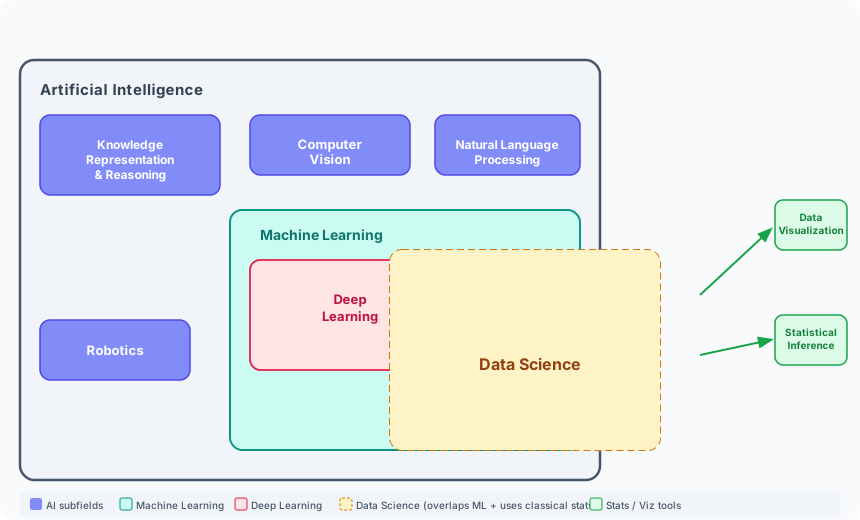
Artificial Intelligence — the umbrella
AI is any technique that lets a machine mimic intelligent behavior.
Think of "AI" the same way you'd think of "sports." Sports is a broad category — football, swimming, chess, rock climbing all count. Saying "I like sports" doesn't tell you much. Saying "I play football" is specific.
AI is the same kind of umbrella. It covers:
- Computer Vision — machines that understand images and video (how self-driving cars see the road)
- Natural Language Processing — machines that understand and generate human language (how ChatGPT works)
- Robotics — machines that sense and act in the physical world (warehouse robots, surgical assistants)
- Knowledge Representation & Reasoning — machines that apply logical rules to draw conclusions (early expert systems, like medical diagnosis programs from the 1980s)
- Machine Learning — and more
AI has been around since the 1950s. What changed recently is that one particular branch — machine learning — got dramatically more powerful.
Machine Learning — AI that learns from data
Machine learning (ML) is a subfield of AI where the computer figures out the rules itself, by looking at examples.
Classic programming works like a recipe: you write every instruction by hand. ML flips this. Instead of writing the rules, you feed the computer thousands of examples and let it discover the patterns.
A concrete example: imagine building a spam filter. The old way: manually list every suspicious phrase ("You've won a prize!", "Click here now!"). The ML way: show the system 100,000 emails already labeled "spam" or "not spam" and let it learn what distinguishes them. It ends up discovering patterns you'd never have thought to write down — like the combination of ALL-CAPS subject lines, certain sending times, and vague sender names.
Another example: banks use ML to assign credit scores. The model looks at thousands of past customers — their repayment history, spending patterns, loan amounts — and learns which combinations predict whether someone will repay. No human had to write those rules. The model discovered them.
ML is the reason the last decade of AI progress happened so fast.
Deep Learning — ML with neural networks
Deep learning (DL) is a specific type of machine learning that uses large, layered networks of calculations inspired loosely by how neurons connect in a brain.
The "deep" in deep learning just means many layers — each layer extracts a slightly more abstract feature from the data.
Example: When your phone recognizes your face to unlock, it uses deep learning. The first layer detects edges. The next layer combines edges into shapes (eyes, nose, mouth). The next layer combines shapes into a face. By the final layer, it knows: that's you.
Deep learning is what powers face recognition, voice assistants, image generation, and large language models like ChatGPT. It requires a lot of data and computing power, which is why it only became practical in the last ~15 years as GPUs became cheap and datasets got huge.
The key relationship: Deep Learning ⊂ Machine Learning ⊂ Artificial Intelligence. Every deep learning system is a machine learning system, which is an AI system — but not the other way around.
Data Science — the broader discipline
Data science is a field that uses a mix of statistics, programming, and domain knowledge to extract useful insights from data.
Data science is related to AI but isn't the same thing. A data scientist might use machine learning models — or they might not. They often reach for classical statistics: hypothesis testing, regression, correlation analysis, data visualization.
A useful analogy: think of a nutritionist vs. a chef. A chef (ML engineer) specializes in one craft — building models. A nutritionist (data scientist) has a broader toolkit — they might run a blood test (statistical analysis), recommend a diet change (data visualization), or suggest a supplement (a simple ML model). The nutritionist uses some chef techniques, but their job is much wider.
Concrete example: A data scientist at a retail company might:
- Use ML to predict which products a customer will buy next
- Or do a simpler analysis: "do customers who visit the website more than 3 times per week spend 40% more in-store?" — a correlation, not an ML model
Both tasks count as data science. Only the first uses ML.
How they all fit together
Look at the diagram again. The nesting goes:
- AI is the biggest box — the general goal of intelligent machines
- ML sits inside AI — one powerful method for achieving that goal
- Deep Learning sits inside ML — one particularly powerful method within ML
- Data Science overlaps with ML but extends outside the AI box — it includes statistical tools that have nothing to do with machine learning
The fields talk to each other constantly. A data scientist might train a deep learning model. A computer vision researcher almost certainly uses deep learning. An NLP system is almost always built on ML. But the terms aren't interchangeable — each one points to a specific thing.
Key takeaway
You don't need to pick a lane. But understanding the map helps you:
- Know what someone means when they say "we're using AI" (probably ML, possibly deep learning)
- Ask the right follow-up questions ("is this a rule-based system or a trained model?")
- Choose the right tool: sometimes a simple statistical correlation tells you more than a complex model
The goal isn't to memorize a taxonomy. It's to think clearly about which type of intelligence — and which technique — fits the problem at hand.
What's next?
Now that you can tell these fields apart, the next lesson goes one level deeper: how does machine learning actually work? What happens during training, and why does it produce models that generalize to new data?