Working with Generative AI
Fine-Tuning: Reshaping a Model's Weights for a Specific Job
5 min read
What "fine-tuning" really means
Every other technique in this lesson leaves the model untouched — you change what goes into it (prompt engineering) or what it can look up (RAG), but its underlying weights, the billions of numbers that encode everything it learned during training, stay exactly as they were.
Fine-tuning is different: it changes the weights themselves. You take a model that has already been through the training pipeline described in How LLMs Are Trained, and you continue training it — this time on a smaller, carefully chosen dataset that represents the specific behavior you want.
Think of it like the difference between handing someone a reference manual before a task (RAG), giving them very clear instructions (prompt engineering), versus actually putting them through a specialized training course that changes how they approach the work from then on (fine-tuning).
What a fine-tuning run actually involves
- Curate a dataset. This is usually the hardest and most expensive part. You need examples of the input-output behavior you want — often hundreds to tens of thousands of high-quality, representative pairs. Poor or biased examples will be learned just as readily as good ones.
- Choose what to train. You can update all of the model's weights (full fine-tuning) or only a small additional set of parameters layered on top of a frozen base model (parameter-efficient fine-tuning). More on this distinction below.
- Run training. The model processes your dataset repeatedly, and its weights shift — gradually — toward producing your desired outputs. This requires significant compute (typically GPUs or TPUs running for hours to days) and careful tuning of training settings to avoid both under- and over-fitting.
- Evaluate and iterate. You test the fine-tuned model against held-out examples, check for regressions in general capability, and often repeat the cycle with adjusted data or settings.
This is meaningfully different from prompt engineering's "type, run, see result, adjust" loop — each iteration here can take hours and cost real money in compute.
Full fine-tuning vs. parameter-efficient fine-tuning (LoRA)
A model like GPT-4 or Llama has billions of parameters. Updating all of them requires enough memory to hold the model, its gradients, and its optimizer state simultaneously — often several times the size of the model itself. For a long time, this put fine-tuning out of reach for all but the largest organizations.
Parameter-efficient fine-tuning (PEFT) methods solve this by freezing the original weights entirely and inserting a small number of new, trainable parameters alongside them. The most popular such method is LoRA (Low-Rank Adaptation), introduced by Microsoft researchers in 2021 (Hu et al., "LoRA: Low-Rank Adaptation of Large Language Models," 2021). LoRA adds small "adapter" matrices to specific layers of the model; only those adapters are trained, while the original billions of parameters stay frozen.
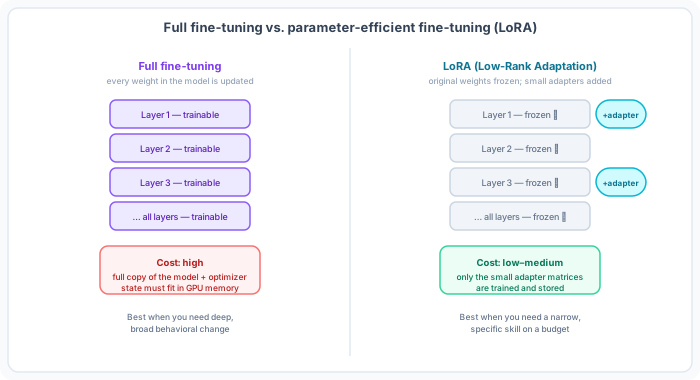
The practical implications are significant:
- Memory and cost drop dramatically — often by 90%+ — because you're only training a small fraction of the parameters.
- You can store many small adapters for different tasks, and swap them in and out of the same frozen base model, rather than maintaining many full copies of a multi-billion-parameter model.
- The trade-off is that LoRA and similar methods are best suited to narrower behavioral shifts; for very deep, broad changes in how a model reasons, full fine-tuning (or training from scratch) may still outperform it.
This is part of why fine-tuning has become more accessible in recent years — what once required a research lab's budget can now sometimes be done on a single high-end GPU.
When fine-tuning earns its cost
Fine-tuning is the right call when:
- You need a specific style or format deeply internalized — for example, a model that always responds in your brand's voice, or always outputs a particular structured format, more reliably than instructions alone can guarantee.
- You need consistent accuracy on a narrow, well-defined task — like classifying support tickets into your company's exact category taxonomy — where a smaller fine-tuned model can match or beat a much larger general-purpose model.
- Latency or cost at scale matters. A smaller model fine-tuned for one job can be faster and cheaper to run in production than repeatedly prompting a larger general-purpose model with lengthy instructions.
It's usually not the right first move when:
- The problem is a knowledge gap (that's RAG's job).
- You haven't yet exhausted what careful prompting can do — which costs nothing to try and iterates in seconds rather than days.
- You don't have — or can't realistically gather — enough high-quality example data. Fine-tuning on a small or noisy dataset can make a model worse: more narrowly confident, but confidently wrong.
For a deeper technical treatment, Hugging Face's fine-tuning guide and OpenAI's fine-tuning documentation both walk through the practical mechanics in more detail.
Key takeaway
Fine-tuning is the only one of the three techniques that changes what the model is, rather than what it sees. That makes it the most powerful — and the most expensive and slowest to iterate on. Methods like LoRA have made it dramatically more accessible by training only a small set of new parameters instead of the whole model, but the fundamentals remain: you need good data, real compute, and a clear sense that prompting and retrieval genuinely can't get you there. Most production systems reach for fine-tuning last — after prompt engineering and RAG have been pushed as far as they'll go.