From Language Models to LLMs
Building an LLM: The Full Pipeline
6 min read
What it actually takes
Building a large language model is not a single step. It's a multi-phase engineering and research pipeline that takes months of work from large teams with substantial infrastructure.
Understanding each phase helps you evaluate AI systems more critically — and explains why, as we'll see in later lessons, most organizations don't build their own.
Here's the full pipeline at a glance — seven phases split across two broad stages: first designing and training the model, then shaping it into something people can actually use.
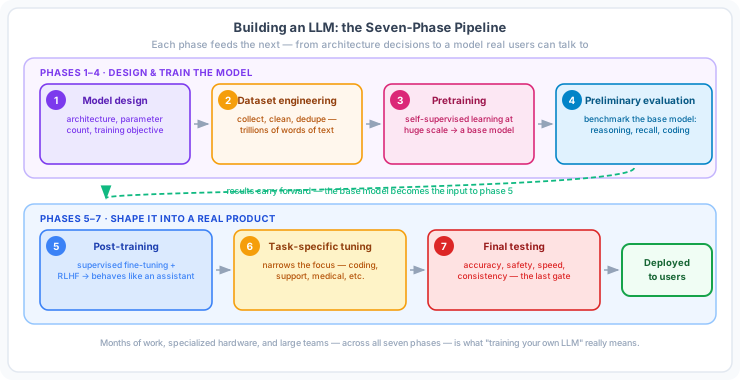
| Phase | What is this phase? | Why is it needed? | Phase description |
|---|---|---|---|
| 1. Model design | Choosing the model's architecture and core training setup | These early decisions shape capacity, cost, and behavior for everything that follows | The team selects the architecture (almost always a transformer), parameter count, and training objective before any training begins |
| 2. Dataset engineering | Collecting and preparing the text the model will learn from | A model can only be as good as the data it learns from — both quality and scale matter | Hundreds of billions to trillions of words are gathered from the web, books, and code, then filtered, deduplicated, and reviewed for ethical concerns |
| 3. Pretraining | The main training run where the model learns language from scratch | This is where the model actually acquires its broad knowledge of language and the world | Using self-supervised learning, the model is exposed to the entire corpus on specialized hardware over weeks to months, producing a raw base model |
| 4. Preliminary evaluation | Benchmarking the freshly pretrained base model | Teams need to know where the base model is strong or weak before investing further | The base model is tested on reasoning, factual recall, language understanding, and coding benchmarks |
| 5. Post-training | Teaching the base model to behave like a helpful assistant | A raw base model can predict text but doesn't yet know how to be helpful, safe, or honest | Supervised fine-tuning on curated examples, plus RLHF on human preference ratings, reshape the model's responses toward what people actually want |
| 6. Fine-tuning for specific tasks | Specializing the general-purpose assistant for a particular use case | A model tuned for one job can be faster, cheaper, and more accurate than a generalist | The post-trained model is further trained on domain-specific data — for coding, customer support, medicine, and similar applications |
| 7. Final testing and evaluation | The last quality gate before the model reaches real users | Mistakes caught here prevent unsafe, unreliable, or unusable products from shipping | The model is checked end-to-end for accuracy, safety, speed, and consistency across a wide range of scenarios |
Phase 1: Model design
Before training starts, the team makes fundamental architectural decisions:
- Architecture type: Almost all modern LLMs use the transformer architecture, but the specific configuration — number of layers, size of each layer, attention mechanism design — varies significantly.
- Parameter count: More parameters means more capacity but also more compute, memory, and training time. This is a trade-off determined early.
- Training objective: Autoregressive (predict next token) is most common, but some models use masked prediction or hybrid objectives.
These decisions shape everything that follows.
Phase 2: Dataset engineering
Data is the substrate the model learns from. Dataset quality matters enormously.
Collection
Training data is gathered from publicly available sources (web crawls, digitized books, GitHub, Wikipedia) and sometimes proprietary datasets. The volume is extraordinary — hundreds of billions to trillions of words.
Preparation
Raw web text is noisy. It contains spam, duplicated content, toxic material, and irrelevant data. The preparation phase filters, deduplicates, and cleans the corpus — a labor-intensive process despite being largely automated.
Ethical considerations
What's in the training data shapes what the model learns, including its biases. Developers must think carefully about data diversity, representation, and potential harms baked into the source material. These decisions are consequential and often contested.
Phase 3: Pretraining
With architecture and data in place, training begins. The model is exposed to the entire corpus — in self-supervised fashion — and learns to predict the next token from context.
This phase is where the bulk of the compute happens. Training a frontier model can require:
- Thousands of specialized AI accelerator chips running in parallel
- Weeks to months of continuous computation
- Tens of millions of dollars in compute costs
The output is a base model: highly capable but raw. It predicts statistically plausible text — but it doesn't yet know how to be helpful, safe, or honest.
Phase 4: Preliminary evaluation
Before post-training, teams evaluate the base model on a battery of benchmarks — tests of reasoning, factual recall, language understanding, and coding ability. This surfaces where the model excels and where it needs improvement.
These results inform the next phases.
Phase 5: Post-training
The base model is shaped into something usable through two primary techniques:
Supervised fine-tuning (SFT): The model is trained on a curated dataset of high-quality examples — human-written or human-approved responses to prompts. This teaches it how a good assistant should respond.
Reinforcement learning from human feedback (RLHF): Human reviewers compare model outputs and rate which is better. A reward model is trained on these preferences, then used to further optimize the language model toward producing outputs that humans prefer.
This is what turns a base language model into ChatGPT.
Phase 6: Fine-tuning for specific tasks
After general post-training, models are often further optimized for specific applications — coding assistants, customer service bots, medical tools. This narrows the model's focus and can improve performance and efficiency for the target domain.
Phase 7: Final testing and evaluation
Before deployment, the model goes through rigorous evaluation:
- Accuracy and coherence — does it produce correct, sensible outputs?
- Safety — does it refuse harmful requests? Does it hallucinate dangerously?
- Speed — can it respond fast enough for real-world use?
- Consistency — does it behave reliably across edge cases?
Only after passing these evaluations does the model reach users.
Key takeaway
Building an LLM involves seven interconnected phases: architectural design, dataset engineering, pretraining, preliminary evaluation, post-training with human feedback, task-specific fine-tuning, and final evaluation. Each phase involves significant expertise and resources. The full pipeline is why frontier models require massive investment and why most organizations consume rather than build them.
What's next?
You now understand how LLMs are built. The next section focuses on how to use them — three practical techniques that let organizations adapt AI to their specific needs without building anything from scratch.